Hope Gospel Mission Newsletter 8 S. Farwell
St. Eau Claire, WI 54701 715-552-5566 Fall 2001
|
|
|
|
Page One Life Skills Focus of Mission's New Program
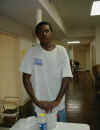
Anthony Kelly, Program Worker, on the job at Crust Unlimited Hope Gospel Mission is proud to announce its new Life Skills Program. It's been operating since August and is now in full swing. Born out of the desire to best meet men's needs, the program is a big step in equipping men for independent living. Hope Gospel Mission has housed homeless men since October 2000. A lot has been learned about them since then. "It's important to us to give a hand up, not a hand out," says Director, Gary Steward. "it became obvious over time that something more was needed to prevent us from enabling men and making them dependant on us. Too many men were spending long periods of time with us with no real change in their lives." Thus, Mark Donnelly,
President of the Board, drew up the initial plans for what has become the Life
Skills Program. Working together with mission staff, the new program was
drawn up to include provisions for such important areas as work, finances,
accountability, and miscellaneous training. While
they are here, men are also receiving the gospel and have regular Biblical
input. Meant
to be four to eight months in length, the program contains four phases in which
men pay their way as much as possible. It is hoped
that one day the program can be a model to others working with the homeless. Consistently
working is the crux of becoming and remaining independent. So one of the first
steps in the new program is getting men working. A new part-time staffer,
Michelle MacGlashin, has been hired for just that purpose. She works
hard scouting the Valley for employers who need workers and are willing to
personally use their business to fight against homelessness and support the work
of the Mission. She strives to get each man a job that he is interested in and
will stick with long term. Men not
working outside the Mission are working inside the Mission. Realizing the
importance of developing a good work ethic in the men, staff hold them
accountable to do four hours of daily chores Monday through Friday. When chores
are completed, the men are expected to be out looking for a job. Another
important facet of the Life Skills Program is teaching men to effectively manage
their finances. It was identified that financial skills in the men were often
weak or nonexistent. So Phase Two of the program addresses this issue. Men are
required to set up a savings and/or checking account. These accounts require two
signatures to withdraw funds. The double signature provides accountability and
promotes self-control. At this time, all Phase Two men are working with their
mentors in the area In Phase
Three men begin serious preparation for independent living. They are hopefully
transitioned into a permanent job. Overnights away from the Mission can begin.
And when one is available, they can move into a two-man room. To keep
things simple, the entire program is wrapped around a “three strikes you’re
out” principle. There are basic rules in force that protect the rights of
others and develop good habits that will aid in each man’s success outside the
program. For example, men are required to be in early at night, most by 6:30p.m. If they come in late they receive a strike. Once a man has a job, he must faithfully report to that job on time each day and work at standards acceptable to the employer. If not, another strike. If
a man gets three strikes, he is out of the program for at least 30 days. He may
re-enter at the end of that time, but would have to begin again from the
beginning. Men are given three chances to successfully graduate from the
program. This
program has another unique point. Men are not simply dropped off the books upon
graduation. In Phase Four they remain under limited guidance for a minimum of
4-6 weeks after they are living on their own. During this time, the
double-signature account will remain The
new program quickly and naturally eliminates men who are not truly interested in
making constructive changes in their lives. It takes commitment and hard work to
remain in the program. When
the Life Skills Program started some thought that the numbers of residents might
remain low. At the “The program has been effective so far,” Steward concludes. “Men are responding positively. We praise God that Hope Gospel Mission can be used to affect men’s lives in such a powerful way. It’s a blessing to be involved in giving men the life skills that will make them successful and independent.” Resident Finds Hope To Overcome
Clifton Morris One
of the things that the new Life Skills Program has accomplished is making a
distinction between those men who want a hand out versus those who want to
change their lives. The
Mission is experiencing a new and positive atmosphere. Most men are excited at
the opportunity to work and earn a paycheck. Many are looking to the future with
an optimism they haven’t had in years. New
resident, Clifton Morris, is a prime example of a man who really desires to get
his life on track and get back on his feet. An alcoholic, he has been out of
sorts for a long time. Even attendance at several treatment programs did not
provide Clifton with what he was looking for. “I did fine until I left the “When
I first got here, I thought it was going to be just like any other Mission. I
would be here a few days, grab some meals and have a roof over my head,” he
continued. But right away Clifton noticed a difference at Hope Gospel Mission.
“I was impressed with the guys who were staying here, and how they conducted
themselves,” he said. Clifton
was also impressed with Mission staff. “It was obvious to me that you were not
just warehousing people here, but providing a way to help people work back into
the community. There is no revolving door policy here.” “I
like the deep spiritual orientation, too. I am an alcoholic, and this place has
gotten me back on track in my spiritual life as well,” Morris continued. Being
here is positive and gives me Hope. This is the first time in a long time that I
have felt that I can overcome my difficulties.” |